Talk by João Sousa Cardoso on the work of Maria Lassnig: Saturday, November 7, 4 pm
Maria Lassnig. The Body without Organs
Maria Lassnig (1919-2014) is a cardinal artist in her sharp questioning of contemporary art as it faced a crisis of the theme, the object and the subject. Across seven decades, through the practice of drawing and painting, her oeuvre ransomed the perceptions of the body by researching the possibilities of surveying and expressing sensations, which in themselves signal mental and emotional states, tensions in interpersonal relationships (particularly gender relationships) and the imperceptible conflicts of psychophysiology.
Relentlessly, Maria Lassnig gaged the movement between the infra-reality of feeling and its visual translation, developing a research methodology and specific formal strategies for the intensive use of line and colour. In drawing and painting (as well as in sculpture, writing and animated film), Maria Lassnig left the raw imprint of an oeuvre that was markedly personal, eminently feminist, sexual and political, and remains fresh today.
Having first trained in the classic rules of Vienna’s Academy of Fine Arts under the Nazi regime, Lassnig travelled to Paris after WWII to make contact with post-cubist figuration and meet surrealists such as Benjamin Péret, Paul Celan and André Breton, while finding in Informalism a liberation from the verist tradition. Likewise, in New York (where she lived between 1968 and 1980 – a transition period from colour field painting, new figuration and pop to the Fluxus movement and the prevalence of happening, performance and body art), Lassnig turned her attention to body awareness (Körpergefühl) as a perceptual engine, opening herself up to internal visions of the material domain. ‘Body-awareness painting’ (Körpergefühlmalerei), in Lassnig’s own terminology, was to deepen ‘introspective experiences’ focused on addressing the unconscious in the drawings (and painting) of the 1950s, while valorising experience according to the procedural and phenomenological principles of the neo-avant-gardes.
But in Maria Lassnig drawing also shares affinities with other artists, recalling Franz Xaver Messerschmidt’s Late Baroque Character Heads, Auguste Rodin’s erotic watercolours and Egon Schiele’s and Oskar Kokoschka’s expressionism. Or the work by coeval artists, such as Thomas Schutte’s wax figures and Marlene Dumas’ sore portraits. At the same time, Maria Lassnig unmistakably belongs to the genealogy of pioneering artists that challenged the dysfunctionality of relationships in the patriarchal system, alongside Meret Oppenheim, Alice Neel or Carol Rama. In fact, in 1974, Lassnig – who had ventured into animated film while in New York –, established the Women/Artist/Filmmakers Inc., together with Carolee Schneemann, Silvianna Goldsmith and Rosalind Schneider, among others, to foster the production, distribution and visibility of films made by women. The body, power dynamics, sensation (which Lassnig prefers over feeling) and the inter-species dialogue (zoology and human figures in their becoming animal) recur in the Austrian’s oeuvre, as she insistently reflected on the mutability of identity, the forces of the archaic and the inevitability of metamorphoses.
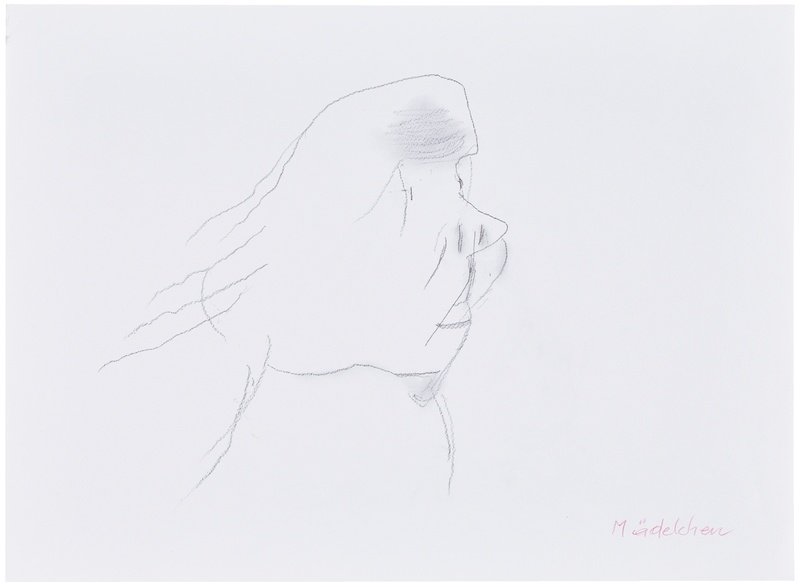
The exhibition The pencil is the best instrument of thinking brings together a set of works on paper (out of 27 graphite drawings, 13 include watercolour, pastel and acrylic, which introduce colour or ‘visual impressions of colour’ into the artist’s expression) produced from 1986 to 2012 at the height of her creative maturity and evoking the constellation of aesthetical problems that ceaselessly occupied Maria Lassnig.
As pencil and brush are hailed as ‘primordial tools’, we find here the outline of isolated figures against a monochrome background or a minimal suggestion of space (a bed, the surface of the sheet of paper, the medium of the canvas); solitary characters, the dialogue between two creatures, or small groups engaged in equivocal meetings; the fragmentation of bodies and the evocation of objects (a glass, a book, a chair, ragdolls or stuffed toys, a wall hanger’s hooks); the graphic contracting of the motif at the centre of the sheet and the exploration of peripheral empty spaces; the use of colour ( following a ‘vertical vision of colour’, without a hierarchy, undergoing constant contagion) in patches that fill in the area circumscribed by the line, or in washes reminiscent of controlled haemorrhaging.
The artist, that ensured us she sought ‘the choice between two possibilities, in life and art’, systematically explores formal, semantic and perceptual ambivalences. The duality emerges in the asymmetry between the plane of citric, or electrified colour (‘oblique colours’), and the line’s intensities; observation drawing and the surrealist processes of automatism (Lassnig often drew with her eyes closed to produce unexpected juxtapositions and associations); the biomorphic elements and the cogwheels of technology; the mastery of portraiture and the forces of the undefined and the unfinished.
The drawings in the current exhibition (Maria Lassnig focused on the practice of drawing precisely in the 1990s), are studies in physiognomy based on self-observation as well as the observation of others (portrait was a constant practice of Lassnig’s), and on a stratigraphy of outlines, with their ruptures, relocations, sfumato and erasures, which describe pregnant elements of memory, now isolated, re-dimensioned, distorted and imbricated in a nervous drive guided by the urgency of the instant (not the photographic instant, however) and the welcoming of all the manifestations of strangeness, at times close to abjection and teratology.
This hypersensitive tracing (like the stylus in a seismograph) records the corporeal mobility of anatomies in transition: a hand that holds a sheet, touching, pointing or drawing gestures of affectivity, defence and abandon; mouths ajar with teeth and jaws that threaten to bite; amputated noses, exposed genitalia, feet in the air, bodies curled on themselves (recalling Maria Lassnig’s iconic photograph lying on the floor as she paints a figure in the same position on the canvas), the heaviness of flesh, instruments to restrain the body, suspended heads detached from the body or resembling hoods, the body undistinguishable from the clothing, the symbiosis of human physiognomy and ‘strange’ entities, hermaphrodites in playful appropriations, anthropomorphised objects, a bulb about to erupt, ovules, a forming foetus, the power of the embryonic body, cellular division and detachment.
Thanks to a cartoon-like economy of the line – disguise and parody (like in Philip Guston, who also drew hooded figures) are never far – we witness a concise play of reversibility, paroxysms or ‘intermediate results’ between contingency and containers, lines of fracture that recreate the (often inverted) distinctive domestic perspective of distinctive still lifes.
However, the pathetic is balanced by affective restraint through a constant distancing effect that brings about a Zen-like ‘meditative’ experience, ‘an expanded sensation of form’ (in the artist’s words) occupied by internal sensoriality, minute feelings, the infra-mental, pre-cultural drives, the intelligent awareness of the body. Lassnig’s drawings that deal with war (mutilations, fragments of bodies, ‘the bleeding and sweating of someone with something to say’) and human transitoriness speak both of the exteriorizing of violence and the marks of trauma (a reminiscence of ‘Viennese Actionism’), as well as of the pondered understanding of pain and – by evoking robotic and humanoid figures – the adaptability of the species.
Influenced by modern poetry (the artist collaborated with Friederike Mayröcker) and scientific literature, Maria Lassnig had been keen, since the advent of the Internet, on the questions of neuroscience, expanding her notion of ‘body awareness’ to the mapping of the neurological aspects of human physiology, which is clear in her works for Documenta X in 1997 (Kassel).
An implausible playfulness intersects a surrealist penchant with the gestural quality of expressionism (between abstraction and figurative resources) and conceptual mockery (as in the title of one of the works in this show: Im Florhof schlafen, dann wirst du eine Blume/Sleep at the Florhof and you will become a flower). The tragic, the absurd, laughter, combinations of a Neo-Dada flavour, all pose a stern challenge to the routines of the civilized gaze.
In Lassnig’s drawing, the tectonics of the body, in which composition and decomposition alternate to discourse about the flesh, the productivity of desire and the fluxes of life, cannot, therefore and historically, but openly and effectively establish a link with the anti-psychiatric movement and Félix Guattari’s and Giles Deleuze’s schizoanalysis. Liberating the individual from the schema of interpretation of psychoanalysis, rooted in the familiar romance, Maria Lassnig translates the plane of immanence, the lines of flight (Deleuze/ Guattari), and the productions of libertarian creativity that react to the social fabric and regulations of capitalism.
In doing so, Maria Lassnig was pointing to the engine of her work: “I have a starting point which arose from the realisation that the only truly real things are my own sensations, which transpire within the house of my body; they are physiological, the sensations of pressure when sitting and reclining, of tension and spatial extension’. The enigma of corporeality, incarnation pierced by energies, which Antonin Artaud touched in his theatre and Guattari and Deleuze identified as the body without organs. The body as a field of conflicts, an outline without substance, a conductor for the intensities of life. Consistency of identity, inner reality and the concreteness of the world turned undistinguishable under the light of a full life. Such is the universal secret that these drawings reveal. With their dark humour. Read More
Text by João Sousa Cardoso